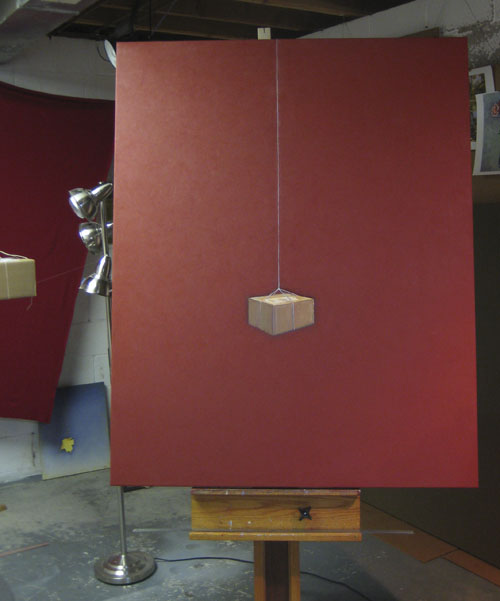
Polished Stone; oil on canvas; 60 x 48 inches


 © Anthony Carré - CNRS 2006
"Fasten an object to the end of a vertically suspended thread. Give it a slight twist and let go. You will observe that the object rotates for a certain length of time and with a certain amplitude, depending on the material of the thread. Now observe a spider suspended from its thread: It is stable, doesn't move, spins its thread in a perfectly straight line and always recovers its balance after environmental disturbances.
By experimenting with a torsion pendulum to which they attached a mass equivalent to a spider's weight, researchers at the Laboratoire de physique des lasers(CNRS/University of Rennes) compared the dynamic reactions of different types of thread to a 90° rotation. The results are revealing: a KevlarTM filament (which is synthetic) behaves like an elastic, with reduced oscillations. A copper thread oscillates slightly but does not return to its original shape, and becomes more fragile as a result of these oscillations. Spider's thread, on the other hand, is very efficient at absorbing oscillations, regardless of air resistance, and retains its twisting properties during the experiments. It also returns to its exact original shape. Certain alloys, such as Nitinol, possess similar properties but must be heated to 90° to return to their original shape.
The amazing properties of spider's thread have been known for several years: its ductility, strength and hardness surpass those of the most complex synthetics fibers . It now also seems that through natural selection, spider's thread has evolved into a material with “self-shape memory effect” which allows it to return to its original configuration without outside stimulus. This complex dynamic process has recently been represented as a “stacked” model which the authors use to depict the relaxation of the different proteins in spider's thread." - from CNRS March, 2006