2.02.2018

seeing double

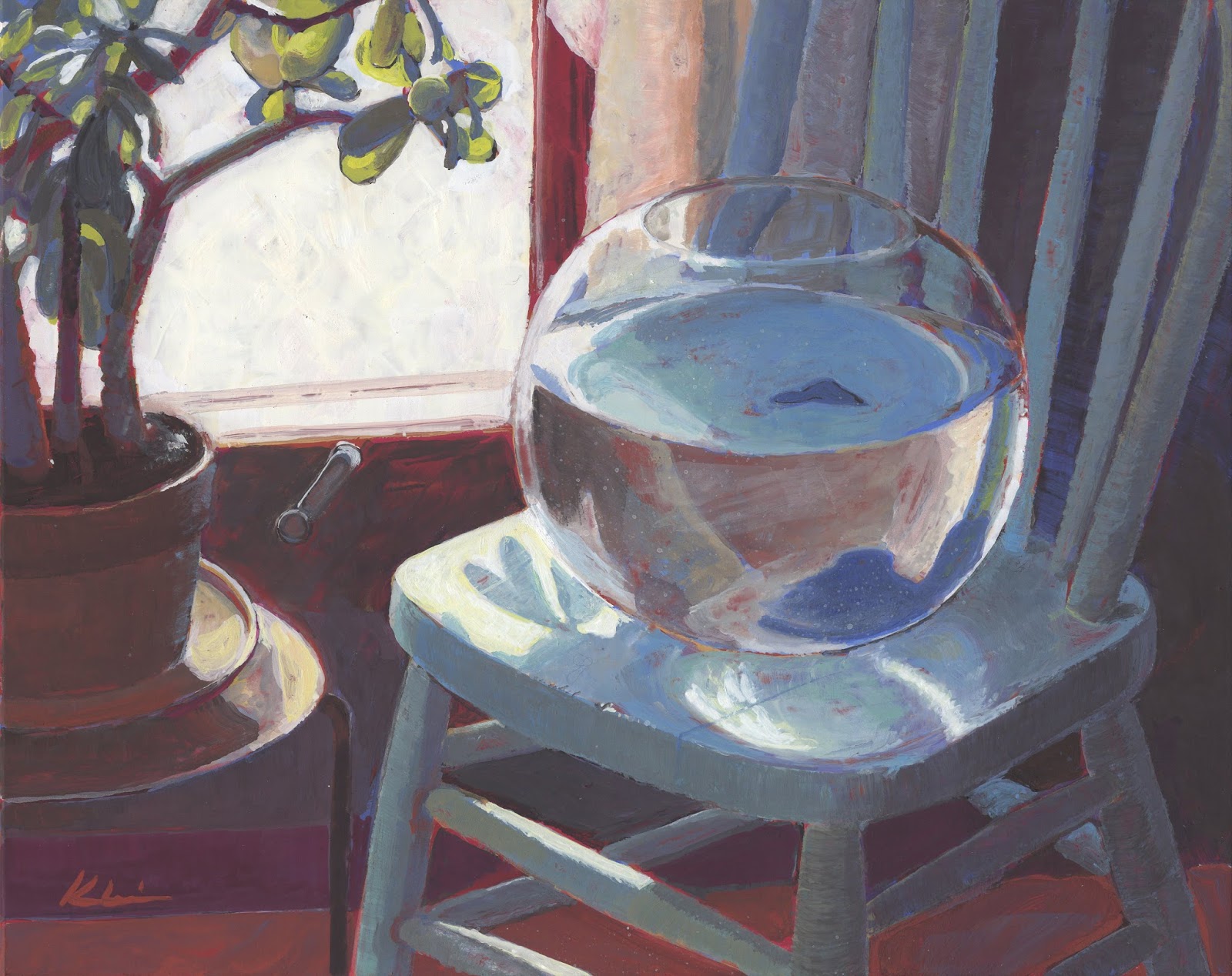
The Betta and the Jade; casein tempera on panel; 8" x 10"

Sandwiched between working on this painting my dog had surgery.  He's an old dog - 11.5 times around the sun - but an oh-so-precious soul.  He had developed a tumor in his toe that destroyed the claw, allowed for a nasty infection and was growing aggressively.  It's gone now.  I don't know if they call it a toe-ectomy but you get the idea.  He's in pain but not as frustrated now that it's gone.  I think it was driving him crazy.  We'll find out soon if it's cancer or not.  But either way, I've got my dog back - and I plan to treasure every day with him.

1.29.2018

virgin snow

Winter Shadows; casein tempera on panel; 8" x 10"

Before it's trodden, by man or beast, fresh fallen snow is truly a magnificent sight.  This is my neighbor's yard - it's what I see when I look out my front windows.  We're fortunate here to live in such a wooded area with the majority of the land left in its natural state.  It's interesting, after snows like this, to look later and see the animal tracks that appear.  Deer, rabbit, mice, wild turkey, squirrels, coyotes and foxes roam our woods.  But mostly, I've been seeing rabbit tracks this winter.  I was quick here though, and got my reference photo before the bunnies hopped through.  It was an amazing opportunity to witness virgin snow in all of its glory.

1.28.2018

in progress

on the easel  - in progress

There are 50 primed panels in the painting rack now.  30 have just been primed with 6 coats of Venetian Red casein and will be ready to paint on in 2 weeks.  The other 20 were primed weeks ago.  I calculated that when my stack runs down to 20, it's time to prime a new batch of 30.  That way I will always have panels on hand.

For those of you wondering when I'm going to paint bigger, I have good news.  10 of my new panels are 9" x 12".  If and when that size feels comfortable, I'll order more at that size and stick to that for awhile.  In this way, I'll gradually increase my painting size.  Ampersand makes Claybord panels as large as 3' x 4'.  We'll have to see if I ever make it that far!

1.26.2018

mad city

From James Madison Park towards the Capitol; oil on unstretched linen; 6.5" x 10.5"; 2003

Facebook has some amazing groups.  I'm in a contemporary still life group, a group dedicated to paintings from the garden and several other artists groups.  I'm also in a couple of groups devoted to the nostalgia of my hometown, Madison, Wisconsin USA.  One's called Historic Madison Wi. Photo Group and the other is Madison in the Sixties.  They're both delightful trips back in time - both in the photos and through the many comments. 

The painting above is of my hometown done in oils with a palette knife.  It's only 15 years old but it still brings back fond memories. I remember setting up my field easel in the park on a golden-sunny-fall day.  The colors were fantastic - especially the orange leaves side-lit by full sun.  It's done on a piece of linen that I taped off so that a thin strip of gesso shows around the edge.  I'm not sure why I never signed it - and now I've given all of my oils away.  It was laying in an archival storage box until I unearthed it tonight. 

settled down

The Lemon; casein tempera on panel; 8" x 10"

This painting was revisited today.  Initially, it felt like a rough treatment for the background was enough.  Or rather, it felt like a finished background was unnecessary.  Apparently the painting had other ideas.  It wouldn't quiet down and kept calling to me.  It's funny how that happens - but it's true.  There's this relentless beaconing that won't be stilled until tended to.  I actually gave it a lot of thought - and examination.

Earlier today, I covered the entire background with a silky matte brown.  That was progress but now it was too flat.  So I came back in again and added some warmer reds to the right.  That's when everything settled down and fell into place.  It's happier now - and feels more like it belongs with my other paintings.  Lessons learned.

1.25.2018

florida vacation

Sunflowers on a White Cloth; casein tempera on panel; 10" x 8"

It's called a poor man's Florida vacation - visiting the Como Conservatory in the middle of winter.  Under vast domes of glass, this Minnesota wonderland houses koi pools, formal gardens, sculptures, a fern room, an orchid house, bonsai exhibits and more.  There's an acre under glass that's been growing since 1915.  On the National Register of Historic Places, there is no charge to visit this Victorian monument - hence the 'poor man's' moniker. You can also visit it  here online.

1.24.2018

getting buffed

Glancing View of Buffed (left) and Unbuffed (right) Paintings


Overhead View of Buffed (left) and Unbuffed (right) Paintings

It's been over six weeks now since I finished my first paintings on Claybord panels.  That's long enough for them to be completely cured and ready to buff.  I'm absolutely loving the way the buffing looks!  It takes the place of varnishing and creates a protective finish for casein - how wonderful is that?  I have an old white wool blanket that I'm cutting in pieces to use as buffing cloths.  The white cloths are clean after buffing which tells me six weeks is plenty of time.  Feeling happy here :)

1.22.2018

snow flowers

on the easel; casein; 10" x 8"

Today was a white-out day.  Every hour through every window was a whirlwind of whiteness.  The Minneapolis airport was closed, events were cancelled and we didn't even bother to shovel.  Tomorrow, we'll deal with the snow.  Today was one to hunker down, be thankful for a working furnace and paint sunflowers.  This is from a reference photo I took when there was still green to be seen from the windows.  A nice reminder of things to come - in a couple of months or so.

something new

Block Study January 22, 2018; casein tempera on board; 6" x 7.5"

I'm writing a book - about seeing and painting color - using casein paint.  Quite a few people have asked me if I've written any tutorials or lesson plans.  In a sense I have - by posting here.  If you were to pore through this blog I'm sure you could glean a lot of helpful information.  But even so, there are missing links - and it would be cumbersome to say the least.

There's a lot to be said for teaching and writing about what you know.  It can reinforce and solidify your skills, force you to communicate your process in an organized way and provide a great deal of satisfaction knowing you've passed on a tiny bit of the vast amount of art knowledge that's gathered over the centuries. 

I'm excited - and busy - painting a quick block study every day (in addition to my regular painting.)  In so doing, I want to revisit the teaching methods of Charles Hawthorne and Henry Hensche (and later Lois Griffel.) They taught an impressionistic painting method using simple-colored-matte blocks that, in my mind, is unsurpassed.  I learned an incredible amount from Lois Griffel's book and credit her with my basic understanding of color and form.  But there's one problem - these were very oil-paint-specific lessons.  It's a whole other animal with casein.  And since there's a dearth of painting instruction on casein - what better way to learn both how to see and paint like an impressionist AND how to paint with casein?  I'm off!
1.21.2018

yellow skies

sale pending: Sumac in January; casein tempera on panel; 8" x 10"

Paintings have a powerful presence.  They can make you aware of so many things you often took for granted.  Take, for example, the color of the sky.  When we were young, we were taught that skies are blue.  In fact, there are entire picture books devoted to assigning basic colors to objects.  But it turns out, as the Impressionists revealed, local color is quite different from what we actually see.  Local color is the picture book color - the one a paint dealer would pick out for you if you brought an object to him and asked him to match the color.  But when taken out of the paint dealer's light and atmosphere - and when adjoined with other objects of differing colors - and pushed back in distance - and mixed with a bit of artistic passion - you end up with another color entirely.  Skies can be green, purple, orange, yellow and - some times - blue.

1.19.2018

photo reference

gathering photo reference in Purgatory Park - January 2018

Here I am - with view finder in mitten-ed hand - at Purgatory Park - in the bitter cold.  And yes, I'm wearing a skirt - and tights - and work boots.  It's all good.

It worked well to find painting material with my view finder, stomp foot prints in place and have my partner step in the prints to take a wide-angled shot.  It was actually a lot of fun!  We're looking forward to going out again next Tuesday.  That's when we should have fresh snow and sunshine - a winning combination. 

Next time, however, I think I'll wear pants - and thermals.  I love skirts - but my knees got pretty cold.

in purgatory

The Snowy Path; casein tempera on panel; 10" x 8"

Today's painting is of a path through Purgatory Park in Minnetonka, Minnesota USA - on a January day with wind chill near 15 below Fahrenheit.  From the city's website: "How did Purgatory get its unusual name? As the story goes, early settlers traveling to Excelsior along an old Native American trail came to some springs around dusk. The trail was the worst they had traveled, with swampy land and a plague of mosquitoes. One of the settlers remarked, “This is hell!” “No, it’s even worse,” another replied, “It’s purgatory!” The name stuck."

1.18.2018

marsh snow

Winter Dusk; casein tempera on panel; 10" x 8"

It was wonderful tromping around this park.  The few other visitors were as bundled up as I - with only their eyes showing through layers and layers of winter clothes.  The dogs had their lovely coats to keep them warm.  Their boundless energy helped too - generating heat to warm them on the trails.  I'm glad for this painting - to remember the day. 

1.16.2018

happy day

In Parallel; casein tempera on panel; 8" x 10"
Yesterday was a happy day here as I found out my painting Door Stop has been juried into the American Impressionist Society's 2nd Annual Impressions Small Works Show.  This is a tremendous honor and privilege - I'm on cloud nine!  I'll be posting more about the show in the next coming weeks as I prepare to frame and ship my painting - and plan my trip to Cincinnati to attend the opening. 

Yesterday was also the second day utilizing a new strategy: set up a still life at 4pm and start painting it at 7pm.  It worked very well.  Beforehand, I was even able to squeeze in a romp through the snow taking reference photos.  Hopefully, that means more snowy landscapes to add to the mix - we will see.

1.14.2018

after noon

Balance; casein tempera on panel; 8" x 10"
Set up the still life at 4pm - then had dinner while watching Netflix (Weeds these days) - started painting at 7pm - now I'm posting the finished painting at 11:45pm.  This could work as a daily practice.  We'll try again tomorrow and see if I can string two days in a row.  But I'm loving this one data point - and the painting that ensued.

the amoeba

A Winter's Evening; casein tempera on panel; 8" x 10"
Now that the holiday festivities are behind me, I've moved back out of the painting nook and have started roaming the house for painting sites.  As a result, the painting detritus is slowly starting to spread.  My partner calls it an amoeba - with a life force of its own.  He's incredibly patient with all of this - even voicing delight in what surprise might be happening next on the easel.  I'm a very lucky painter.

It helps to have several easels to accommodate this fluid-studio-space type of arrangement.  I've got a Julian field easel that I used to paint the above scene in my living room.  It goes with me when I paint outside too.  Then there's the pochade box - which has taken a couple of bike rides to painting sites. (I must admit however that it really hasn't caught on with me.  The hinged lid that holds the painting won't stand up to my brush strokes - and the painting is too close to the palette for my tastes.  And I'm not convinced the whole pochade set-up is any lighter than my Julian field easel - its only real advantage.)  Then there's the table top easel which is simply a 10" x 12" piece of 1/8" plywood with a 12" strip glued to it as a stop.  An old brick sits on the plywood - supporting the back of the painting and keeping it all steady.  This works great when I'm painting at my desk and using my monitor for photo reference - although I far prefer to paint standing up and from life.  Last, but not least, is my heavy studio easel which lives in my 8' x 10' north-facing painting nook.  It can handle large canvases and is a real workhorse.  But I get restless if I stay in the nook too long - even though I do my best to refresh it with new set-ups and backdrops.  It is nice, though, to have a place to retreat to when we're trying to tame the amoeba.

1.12.2018

sun shine

Three White Tulips; casein on watercolor board; 6" x 4" image on a 7" x 5" board
The lovely consequence of the frigid snowy weather we're having is that the sun pours in through the windows and sheers.  And if arranged just so, it will shine through petals, leaves, water and glass too - and create a magical effect.

This is a little piece - and is signed on the back - as it will be part of Art4Shelter's fundraiser for the homeless.  The sale will be on May 9th at the Minneapolis Institute of Arts.  Click HERE to learn more.